
Cable Attachment Storage for Garage Gyms
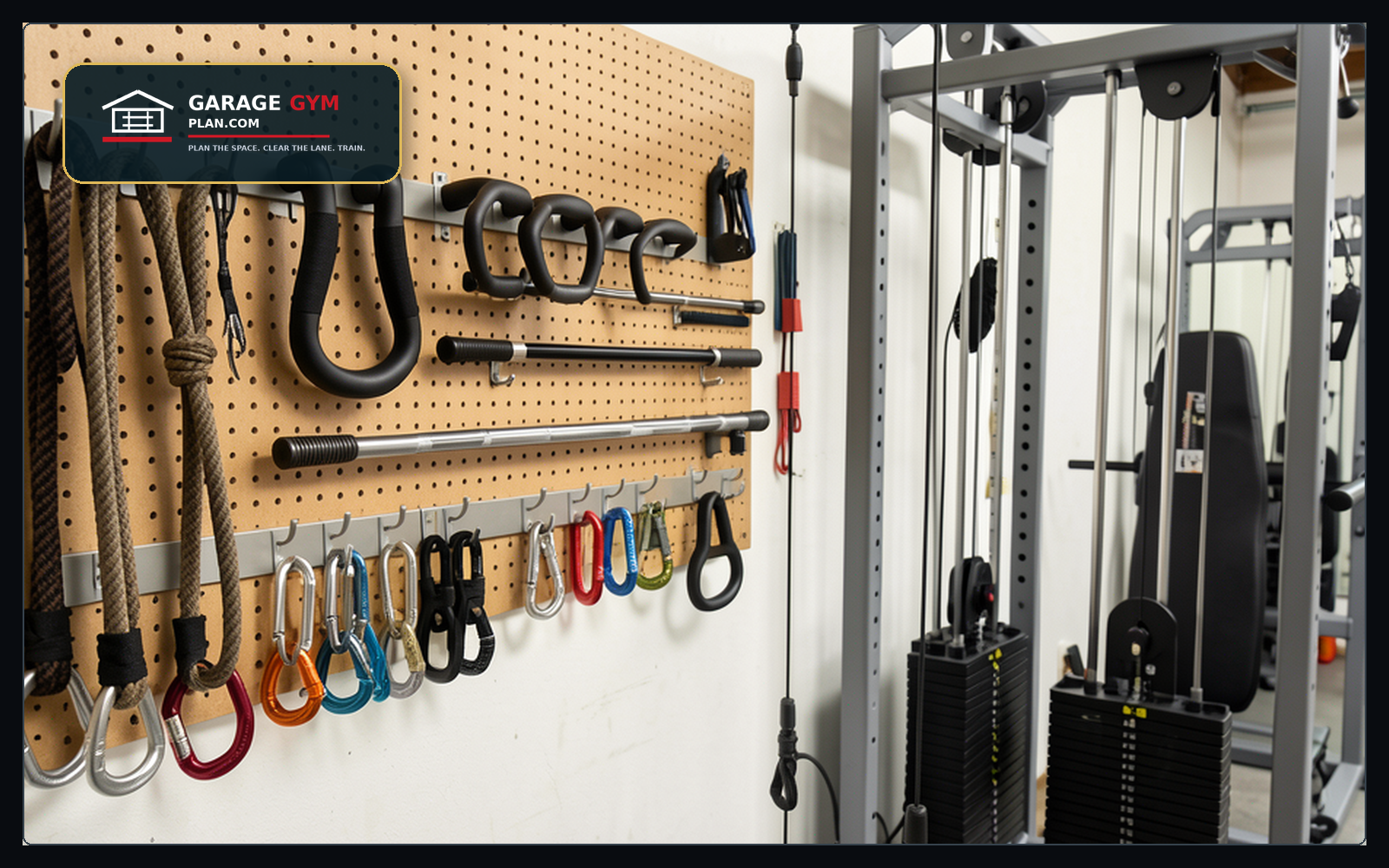
Cable attachments need storage that protects the handles and keeps the right piece easy to grab. The best setup is usually close to the cable station, but not inside the foot path or where metal handles can swing into a car or rack.
Bottom line
Store high-use handles on visible hooks near the cable station. Put occasional attachments in a shallow labeled bin or drawer. Keep clips, straps, and collars in a separate small container so they do not disappear under ropes and bars.
Decision table
| Attachment type | Best home | Avoid | Quick check | Compare |
|---|---|---|---|---|
| Triceps rope | Single hook or peg with the rope hanging free | Stuffing it in a deep bin where it kinks | Enough drop length without touching the floor | View options |
| D-handles and stirrup handles | Paired hooks or a divided tray | Letting pairs separate across the garage | Can you grab both handles in one motion? | View options |
| Lat bar or straight bar | Horizontal wall hooks or vertical corner | A loose bar leaning behind plates | Wall clearance and sleeve/knurl contact points | View options |
| Ankle cuffs, straps, clips | Small labeled box near the pulley | Dropping small parts into the general accessory bin | One visible home for carabiners and pins | Plan first |
Checks before you buy or rearrange
Keep swinging metal away from painted walls and car panels.
Do not place bars where children or pets can pull them down.
Use labels if multiple people train in the same garage.
Check that wall hooks are rated and mounted for the load they carry.
How to use this in a real garage
If the cable station takes more than a minute to set up, attachment storage is part of the problem. The goal is fewer decisions between sets, not a perfect display wall.
Walk the route you use during a normal workout: enter the garage, reach the equipment, load the bar or station, train, unload, and reset. The right storage decision should shorten that sequence and leave the shared garage easier to use after training.
Garage Gym Reset Kit
Measure the garage, choose the storage path, and turn the plan into a printable checklist before buying more equipment.
See the Garage Gym Reset KitFit notes by setup
Triceps rope
Single hook or peg with the rope hanging free is the main fit signal. The practical mistake is stuffing it in a deep bin where it kinks. Before you buy or move anything, use this check: enough drop length without touching the floor. If that check fails, change the location before changing the product.
D-handles and stirrup handles
Paired hooks or a divided tray is the main fit signal. The practical mistake is letting pairs separate across the garage. Before you buy or move anything, use this check: can you grab both handles in one motion?. If that check fails, change the location before changing the product.
Lat bar or straight bar
Horizontal wall hooks or vertical corner is the main fit signal. The practical mistake is a loose bar leaning behind plates. Before you buy or move anything, use this check: wall clearance and sleeve/knurl contact points. If that check fails, change the location before changing the product.
Ankle cuffs, straps, clips
Small labeled box near the pulley is the main fit signal. The practical mistake is dropping small parts into the general accessory bin. Before you buy or move anything, use this check: one visible home for carabiners and pins. If that check fails, change the location before changing the product.
Common mistakes to avoid
- Buying the holder, shelf, jack, or accessory because it looks organized in a photo instead of because it solves your exact lane problem.
- Measuring the product footprint but not the working path around it. Bars, benches, plates, doors, and people need room to move.
- Letting the new storage location create a trip point, toe-stub, car-door conflict, or hard-to-reset corner.
- Keeping too many rarely used items in the premium rack-side zone while the daily-use items sit across the garage.
Good fit vs. bad fit signals
A good setup feels boring after the first week. The item has one obvious home, you can reach it without moving unrelated gear, and the garage still works for parking, tools, bikes, trash cans, and family traffic. A bad setup usually announces itself through repeated small annoyances: a bar that must be tilted past shelves, a hook that catches clothing, a bin that lives on the floor, or a storage product that looks clean only when the garage is empty.
Keep the useful parts and remove the ceremony. If a solution requires multiple reminders, labels, or resets just to stay safe, simplify the zone. Move the item closer to its use point, reduce the number of products in that area, or accept that this garage needs a smaller footprint than the product photo suggests.
Quick test before you call it done
Run one normal workout using the new plan. Set a timer for the setup and reset, then note every item you had to move twice. The page-level goal is not perfect organization; it is a garage that trains cleanly, resets quickly, and does not feel stuffed with keyword-friendly but useless advice.
- Keep swinging metal away from painted walls and car panels.
- Do not place bars where children or pets can pull them down.
- Use labels if multiple people train in the same garage.
- Check that wall hooks are rated and mounted for the load they carry.
Keep, cut, or move
Use this as a decision filter: keep the item or setup if it makes the next workout easier to start, easier to reset, and safer for everyone who shares the garage. Cut it if it only adds another surface, slot, or bin without solving a repeated problem. Move it if the product is useful but sits in the wrong zone.
Most garage-gym clutter is not one bad purchase. It is a chain of almost-good decisions: a holder mounted a little too far from the rack, a shelf that is a little too deep, a bar that fits only when the car is gone, or an accessory bin that is convenient until it becomes the place every small part disappears. Fix the chain by choosing one clear home for the item and one clear lane that storage never crosses.
Before-and-after check
Before changing the setup, take one photo from the garage door and one from the house entry. After the change, take the same photos and ask three questions: is the training lane easier to see, are heavy items lower and more stable, and can a non-lifter understand where to walk? If the answer is no, the garage still needs a simpler plan.
Cable attachment storage checks
Use these numbers as planning checks, not as live product claims. Final purchases should be verified against the current listing and manufacturer instructions.
- Sort by use: Keep daily handles at chest-to-waist height and heavier metal attachments lower. Rare attachments should not occupy the fastest-reach zone.
- Noise and wall protection: Metal attachments can swing, chip paint, and scratch racks. Use bins, rubber-lined hooks, or panels if the wall is finished.
- Planning price band: Budget roughly $15–$40 for simple hooks/rails, more for pegboard or wall-panel systems. Verify current pricing and load ratings.