
Garage Gym Ideas That Start With the Plan, Not the Gear Pile
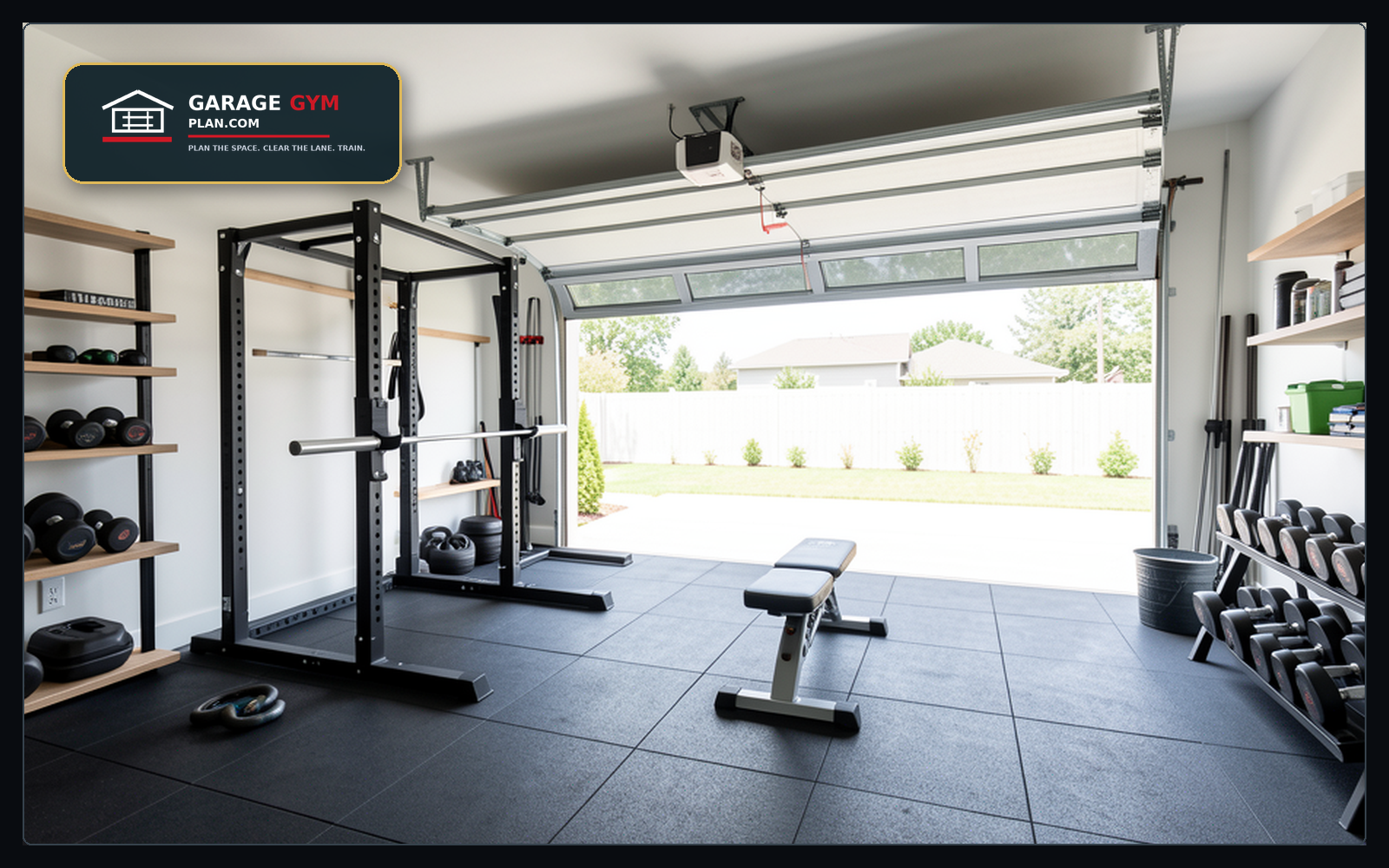
The best garage gym ideas are not just equipment lists. They are layout decisions that make training easier to repeat.
Start by choosing the room role, training zone, storage wall, flooring area, and buying sequence. Then choose equipment that fits those decisions.
Use this hub to move from inspiration to a plan that protects parking, storage, walking lanes, and workouts.
Quick answer
A strong garage gym plan starts with one training anchor, one clear walking lane, one storage wall, and a budget sequence. Choose layout, flooring, rack fit, and storage before adding specialty equipment.
Garage gym layout ideas
One-car garage gym: build around the car path, door track, and one protected training rectangle.
Half-garage gym: split the garage into training, parking, storage, and walking zones.
Rack-centered garage: place plates, bar storage, flooring, and bench parking around the rack before buying attachments.
Dumbbell-first garage: preserve open floor space and use wall storage when a full rack is not realistic.
Conditioning-first garage: give the cardio or sled substitute a clear lane and keep strength gear shallow.
Storage ideas that make workouts easier
Store long items vertical first: barbells, bands, handles, mobility tools, and specialty bars.
Keep plates near the rack but out of the loading stance.
Give the bench a real parking spot so it does not drift into the walking lane.
Put garage items and gym items into separate zones so seasonal storage does not take over the gym.
Flooring ideas by garage type
Use mats or rubber flooring in the actual training zone before covering unused corners.
Use a platform when repeated barbell drops or heavy pulls are central to the training plan.
Keep parking and dirty/wet zones separate from the main workout surface when possible.
Check door thresholds, floor drains, and platform height before ordering.
Budget ideas that prevent wasted purchases
Buy the piece that unlocks repeatable training first.
Reserve money for flooring, storage, collars, safety, and fit fixes.
Add accessories only after the core setup works without constant cleanup.
Delay specialty machines until the room proves it can support them.
Planning ideas before buying equipment
Measure ceiling, door tracks, rack footprint, barbell side-loading, car door swing, walking paths, and storage depth.
Score each plan as PASS, TIGHT, or REDESIGN.
If the plan is tight, choose smaller equipment, folding storage, a dumbbell-first setup, or a staged buying sequence instead of forcing a showroom layout.
Garage gym idea chooser
| Goal | Start with | Next guide | Compare |
|---|---|---|---|
| Strength training | Rack fit, flooring, plate storage | Power rack ceiling height guide | View options |
| Small garage | Car path, folding/reset plan, shallow storage | Small garage gym ideas | Plan first |
| Shared half garage | Boundary, parking side, storage rules | Half garage gym ideas | Plan first |
| Budget build | Train-now equipment and buy-later list | Garage gym budget planner | Plan first |
| Used equipment | Dimensions, condition, pickup plan | Used equipment checklist | Plan first |
Start with a garage gym plan before choosing ideas
Inspiration works best after the plan has a shape. Pick the training anchor, map the walking lane, place the storage wall, and decide what must still happen in the garage. Then choose the equipment and design ideas that support that plan.
A good gym plan also protects future choices. If the first build leaves room for flooring expansion, better storage, or a rack upgrade later, the site can improve without buying everything twice.
- Strength anchor: rack, bench, barbell, plates, and nearby storage.
- Dumbbell anchor: adjustable dumbbells, bench parking, clear pickup space, and wall hooks.
- Conditioning anchor: machine or mat lane with enough reset space for strength accessories.
- Hybrid anchor: one main lift station plus a shallow storage wall and a movable mat zone.
Small garage ideas that still feel usable
A small garage needs fewer permanent obstacles and more deliberate reset rules. Put bulky items where they do not block the car door, house entrance, utility access, or barbell loading path.
The easiest wins are often shallow wall storage, vertical bar storage, a defined mat edge, and a bench parking spot. These ideas do not photograph as dramatically as a giant machine, but they make the room easier to train in every week.
Ideas by buying stage
Early-stage gyms should focus on a floor zone, one training anchor, and storage that keeps setup fast. Mid-stage gyms can add specialty bars, cable attachments, extra dumbbells, or a better rack after the room proves it works.
Late-stage upgrades should solve a known training problem rather than fill empty floor space. If a machine, platform, or storage system does not improve repeatable workouts, keep it on the buy-later list.
Garage gym ideas by training style
A strength-first garage should make the rack or lifting lane the anchor, then place plates, bars, bench storage, and flooring around that anchor. A conditioning-first garage should protect open floor, machine clearance, airflow, and cleaning. A bodybuilding or dumbbell-first garage should make pickup height, mirror or lighting placement, bench movement, and dumbbell storage easier.
Choosing by training style keeps the room from becoming a random collection of good ideas that compete with each other.
- Strength: rack, bench path, plates, bars, flooring, and safe loading room.
- Conditioning: clear lane, ventilation, sweat cleanup, cord control, and movable accessories.
- Dumbbell-first: adjustable or fixed weights, bench parking, shallow rack, and open floor.
- Family/shared: boundaries, labels, safe storage, and fast reset rules.
Visual ideas that also improve function
Good-looking garage gyms usually have the same hidden structure: fewer floor piles, clear zones, lighting that reaches the rack, and storage that matches workout order. Paint, flags, signs, and matching bins help most after the layout works.
If a design idea makes the garage feel cleaner but adds setup time, treat it as decoration, not a planning decision. The best visual upgrades make the next workout easier to start.
- Use a visible mat edge to show the workout boundary.
- Use labels for bins and hooks so cleanup is obvious.
- Use lighting over the rack, open floor, and storage wall instead of one dim center bulb.
- Use one consistent wall for accessories so the room reads as a gym, not scattered storage.
Ideas to avoid until later
Some garage gym ideas are exciting but should stay on the later list until the basics work: large cable machines, specialty bars, heavy cardio machines, full-wall storage systems, or platform builds that change ceiling clearance. These can be great upgrades, but only when they solve a known problem.
If the room still lacks a safe walking lane, clear plate storage, a bench parking spot, or a repeatable first workout, spend the next improvement there before adding another centerpiece.
- Wait on machines until the workout lane and storage wall are stable.
- Wait on premium accessories until the core lifts or sessions are consistent.
- Wait on full-room cosmetic upgrades until the garage has survived a month of real use.
Build the idea list into a sequence
Turn inspiration into a sequence: first measure, then mark zones, then choose the training anchor, then place storage, then buy the first equipment, then test workouts. This keeps the idea list grounded in the room instead of in product photos.
A garage gym can improve in layers. The first layer should create workouts. The second layer should reduce friction. The third layer should add variety. The fourth layer can make the space feel polished.
- Layer one: usable training setup.
- Layer two: safer floor, clearer storage, and faster reset.
- Layer three: accessories that support the training plan.
- Layer four: cosmetic, comfort, and specialty upgrades.
Fast upgrades for a garage gym that already works
Once the first setup works, improve the parts that make workouts easier to repeat. Add a better light over the rack, a fan or airflow plan for hot months, a chalk or towel station, a phone shelf, and labels for small accessories. These upgrades are inexpensive compared with another machine, but they reduce the daily friction that keeps people from training.
A useful garage gym idea should either start the workout faster, make the workout safer, improve recovery between sets, or make cleanup obvious. If it only fills a blank wall, it is decoration and can wait.
- Add task lighting where form, loading, or setup happens.
- Create a small recovery station for towels, water, timer, and notes.
- Use hooks for small items that otherwise land on the floor.
- Keep one clear photo-worthy reset state so the room has a default look.
Use this in the Garage Gym Planning System
Use the Garage Gym Planning System to turn these ideas into a measured layout, flooring plan, rack-fit score, budget sequence, and shopping shortlist.
- Worksheet module: planning hub + module router
- Best next step: measure the room, score the fit, and place this purchase into a buy-now or buy-later sequence.
- Planning value: fewer wrong purchases, faster setup, and a gym that stays easier to use.
Related planning guides
- Small garage gym ideas
- Garage gym flooring guide
- Power rack ceiling height guide
- Garage gym budget planner
- Used equipment checklist
Garage Gym Ideas: the practical planning layer
Use this section when the basic answer is not enough and you need to decide how the setup should work in a real garage. The goal is not to add more gear; it is to make the garage gym ideas choice fit the way you train, park, clean, and move through the space.
Gaps to solve before you buy or rearrange
- Comprehensive budgeting guide and cost breakdown for various garage gym setups (budget-friendly to high-end).. Comprehensive budgeting guide and cost breakdown for various garage gym setups (budget-friendly to high-end).
- Solutions for climate control, insulation, and ventilation in garage gyms for year-round comfort.. Solutions for climate control, insulation, and ventilation in garage gyms for year-round comfort.
- Advanced space-saving hacks and multi-functional equipment recommendations for extremely small or shared garage spaces.. Advanced space-saving hacks and multi-functional equipment recommendations for extremely small or shared garage spaces.
- DIY projects and custom build instructions for equipment, storage, or flooring to personalize a garage gym.. DIY projects and custom build instructions for equipment, storage, or flooring to personalize a garage gym.
- Detailed guide on essential safety considerations, including flooring, lighting, and securing heavy equipment.. Detailed guide on essential safety considerations, including flooring, lighting, and securing heavy equipment.
Choose this approach when
- Buy the piece that removes the biggest training bottleneck first, not the piece that looks best in a finished gym photo.
- Check footprint, storage, warranty, return rules, and replacement parts before ordering.
- A cheaper item is not cheaper if it forces a second purchase or blocks the main lift lane.
- You can explain where the item starts, where it goes during the workout, and where it returns afterward.
- The choice improves the main training lane instead of only making the room look more finished.
- The setup still works on a tired day when you are less careful about putting everything back perfectly.
Planning modules to work through
Introduction to Your Dream Garage Gym
- Benefits of a home gym and the growing trend
- What to expect from this comprehensive guide
- Creating a personalized workout space tailored to your needs
Why a Garage is the Perfect Home Gym Location
- Advantages of dedicated space and potential for expansion
- Privacy and convenience compared to commercial gyms
- Long-term savings on gym memberships and travel time
Essential Planning Steps Before You Build
Use this part of the plan to compare the option against your actual floor space, access path, storage return path, and budget. If it does not improve one of those, it is probably not the next upgrade.
Assess Your Space and Layout
- Measuring dimensions, ceiling height, and door clearances
- Considering vehicle storage and multi-purpose use
- Sketching potential layouts for optimal flow
Define Your Training Style and Goals
- Identifying your primary workout focus (e.g., strength, cardio, CrossFit, yoga)
- Prioritizing equipment based on your fitness objectives
- Setting realistic budget expectations for your setup
Environmental Considerations
- Addressing insulation, heating, and cooling needs
- Ensuring adequate ventilation and air circulation
- Planning for sufficient lighting and electrical outlets
Terms and fit checks to keep straight
These related ideas tend to appear around this topic. Use them as fit checks, not as a shopping list:
- Garage Gym: confirm that this detail applies to your garage, your equipment, and your training style before treating it as a must-have.
- Home Gym: confirm that this detail applies to your garage, your equipment, and your training style before treating it as a must-have.
- Gym Ideas: confirm that this detail applies to your garage, your equipment, and your training style before treating it as a must-have.
- Garage Ideas: confirm that this detail applies to your garage, your equipment, and your training style before treating it as a must-have.
- Half Garage: confirm that this detail applies to your garage, your equipment, and your training style before treating it as a must-have.
- Gym Setup: confirm that this detail applies to your garage, your equipment, and your training style before treating it as a must-have.
- Layout Ideas: confirm that this detail applies to your garage, your equipment, and your training style before treating it as a must-have.
- One Car: confirm that this detail applies to your garage, your equipment, and your training style before treating it as a must-have.
- Workout Area: confirm that this detail applies to your garage, your equipment, and your training style before treating it as a must-have.
- Storage Solutions: confirm that this detail applies to your garage, your equipment, and your training style before treating it as a must-have.
Before-and-after layout check
- Measure the clear walking lane with the garage door open and closed.
- Mark the equipment footprint with painter tape, including the space needed to load, unload, and turn around.
- Stand where you will start the workout and make sure the first action is obvious.
- Put the heaviest or most awkward item back in its storage spot three times; if that feels clumsy, move the storage lower or closer.
- Check whether the setup still leaves a simple path for cleaning, parking, trash bins, bikes, or family gear.
- Take one photo from the garage entry and one photo from the rack area; if either view looks blocked, simplify before buying more.
Common questions
How much does it cost to set up a garage gym?
The cost varies widely, from a few hundred dollars for a minimalist setup with essential free weights and bands, to several thousand for a fully equipped gym with a power rack, cardio machines, and specialized flooring. Your budget and training style are the primary determinants of the overall investment.
Does a home gym add value to my house?
While a dedicated home gym might appeal to certain buyers, it generally doesn't add significant appraised value to your home in the same way an extra bedroom or bathroom would. However, it can be an attractive feature for fitness-minded individuals, potentially making your home more marketable.
What is the best flooring for a garage gym?
Rubber flooring is widely considered the best option for a garage gym due to its durability, shock absorption, noise reduction, and easy maintenance. Interlocking rubber tiles or rolled rubber sheets protect your concrete floor and equipment while providing a safe surface for workouts.
How do I manage temperature and ventilation in a garage gym?
Managing temperature and ventilation involves solutions like portable fans or industrial-grade fans for airflow, and potentially a portable AC unit or heater for extreme weather. Proper insulation, weatherstripping around doors, and even opening garage doors when feasible can also help regulate the environment.
Can I create a functional gym in a small garage space?
Absolutely. Even a small garage can host a functional gym by utilizing compact and foldable equipment such as wall-mounted racks, adjustable dumbbells, resistance bands, and multi-functional benches. Smart storage solutions, like vertical shelving, are key to maximizing limited space efficiently.
When to keep it simple
Do not overbuild this page’s recommendation into a full-room remodel if the bottleneck is small. For many garage gyms, the right next move is one clear return spot, one better measurement, or one safer walking lane. Upgrade only after the current setup proves what is actually slowing down the workout.
For a deeper plan, pair this page with the garage gym measurement checklist, the layout cheat sheet, and the organization planner.
Garage Gym Reset Kit
Measure the garage, choose the storage path, and turn the plan into a printable checklist before buying more equipment.
See the Garage Gym Reset KitMeasurement and buying sanity checks
Use these numbers as planning checks, not as live product claims. Final purchases should be verified against the current listing and manufacturer instructions.
- Measure before product: Write down the exact wall width, depth, ceiling height, car-door swing, walking lane, and where the item will reset after a workout.
- Use price bands carefully: Treat price ranges as planning estimates only. Verify current prices, shipping, dimensions, ratings, and return policies on the live listing.
- Keep the lane clear: The best-looking storage is a bad choice if it creates a toe-stub, blocks the car, hides daily gear, or requires moving three items before training.