
Garage Gym Tool Storage: Keep Tools, Hardware, and Gym Gear from Mixing
Tools and gym accessories can share a garage without sharing every shelf. Separate use cases so workouts are not slowed by searching.
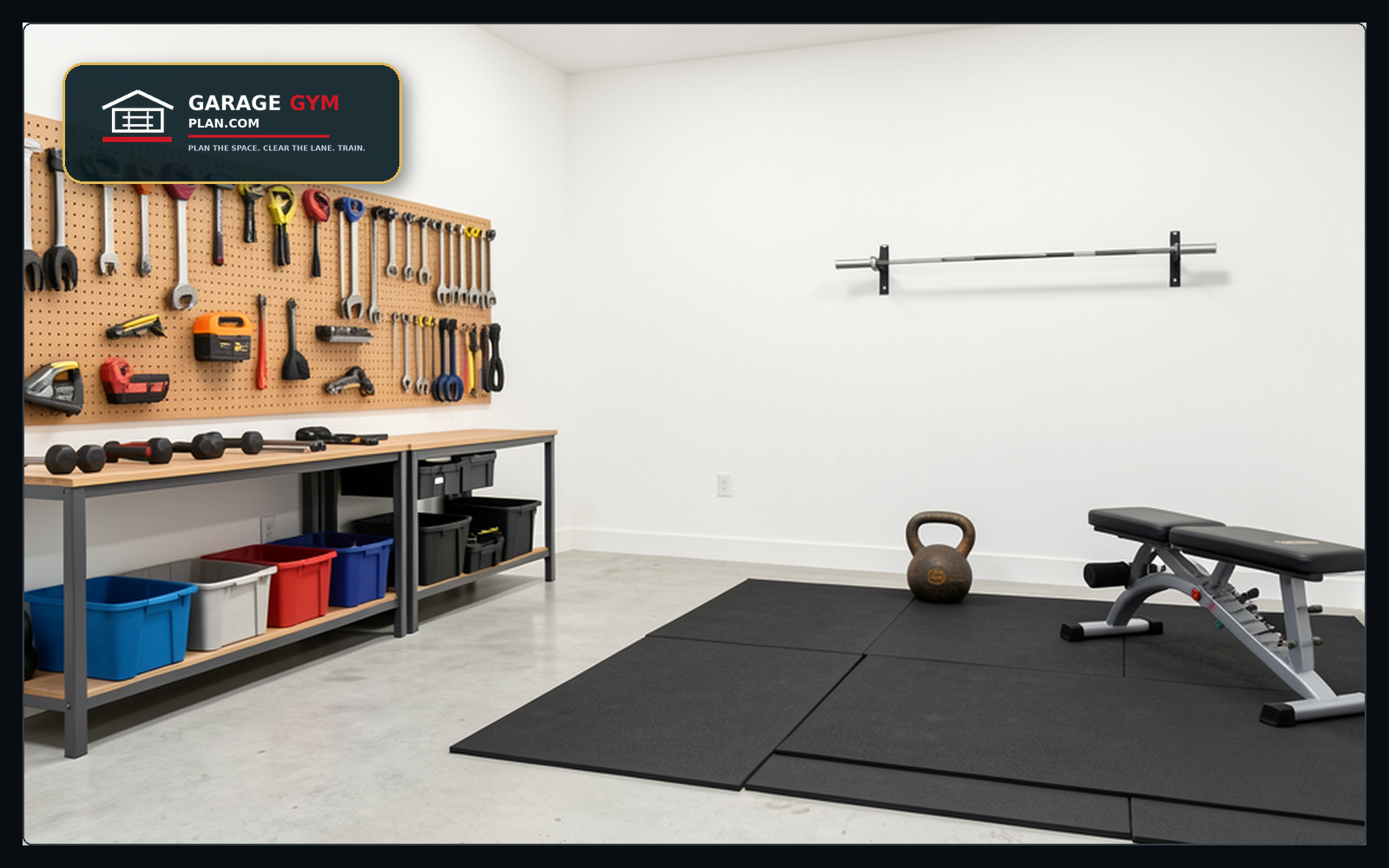
Use this guide if
- Your garage is both a workshop and a gym
- Rack hardware, collars, clips, and tools disappear between sessions
- You need a cleaner boundary between house projects and training
The planning sequence
- Step 1: Create one gym hardware tray for collars, clips, pins, and small parts
- Step 2: Keep house tools on a separate panel or shelf from workout accessories
- Step 3: Label bins by use rather than by vague category
- Step 4: Store setup tools close to adjustable equipment
- Step 5: Review the shelf monthly and remove items that do not support training
Common mistakes to avoid
- Letting tools migrate onto the rack or bench
- Storing collars with general hardware
- Using deep mixed bins for items needed during every workout
What to compare before you buy
Use a small visible tool zone near the rack or utility wall. Deep household tool boxes are fine for rarely used tools, but gym pins, wrenches, tape, and collars need fast access.
| Product path | Use it when | Check before ordering | Compare |
|---|---|---|---|
| Small Parts Organizer | Best when it solves losing the small tools and hardware needed to adjust, repair, or reset the gym without crowding the training lane. | Verify size, mounting/support, capacity language, and return rules on the current product page. | Plan first |
| Wall Tool Panel | Best when it solves losing the small tools and hardware needed to adjust, repair, or reset the gym without crowding the training lane. | Verify size, mounting/support, capacity language, and return rules on the current product page. | Plan first |
| Labeled Storage Bins | Best when it solves losing the small tools and hardware needed to adjust, repair, or reset the gym without crowding the training lane. | Verify size, mounting/support, capacity language, and return rules on the current product page. | View options |
- Separate gym-use tools from household repair tools.
- Label hardware and spare parts before they become mystery pieces.
- Check bin depth, wall-panel compatibility, and load limits before mounting.
Garage Gym Plan may earn from qualifying retailer links. Search links are starting points, not final endorsements; verify the current product specs and installation instructions before buying.
Garage Gym Reset Kit
Measure the garage, choose the storage path, and turn the plan into a printable checklist before buying more equipment.
See the Garage Gym Reset KitTrust check for this decision
The safest choice is the one that fits your measured room and the manufacturer’s current installation requirements. Do not rely on a category name alone. Match the product dimensions to your rack zone, wall structure, walking lane, and storage reset routine.
Before checkout, compare the product page against your garage notes: clearance, mounting surface, weight capacity language, included hardware, delivery weight, and return window. If any of those details are unclear, choose the more conservative option or keep planning with the Garage Gym Reset Kit.
Next pages to plan with this
Use these guides to connect the layout decision to measurement, storage, flooring, and buying order.
Garage Gym Tool Storage: the practical planning layer
Use this section when the basic answer is not enough and you need to decide how the setup should work in a real garage. The goal is not to add more gear; it is to make the garage gym tool storage choice fit the way you train, park, clean, and move through the space.
Gaps to solve before you buy or rearrange
- Detailed solutions for storing small gym accessories (resistance bands, jump ropes, lifting straps, mobility balls) beyond general"equipment" storage.. Detailed solutions for storing small gym accessories (resistance bands, jump ropes, lifting straps, mobility balls) beyond general"equipment" storage.
- DIY projects and budget-friendly hacks specifically for organizing small tools and gym essentials in a garage setting.. DIY projects and budget-friendly hacks specifically for organizing small tools and gym essentials in a garage setting.
- Vertical and wall-mounted storage ideas tailored for small gym tools and maintenance items, optimizing limited garage space.. Vertical and wall-mounted storage ideas tailored for small gym tools and maintenance items, optimizing limited garage space.
- Comparison of different tool organization systems (e.g., pegboards, magnetic strips, small utility carts) suitable for a dynamic gym environment.. Comparison of different tool organization systems (e.g., pegboards, magnetic strips, small utility carts) suitable for a dynamic gym environment.
- Integrating tool and accessory storage directly into existing gym equipment (racks, benches) or creating multi-functional storage units.. Integrating tool and accessory storage directly into existing gym equipment (racks, benches) or creating multi-functional storage units.
Choose this approach when
- Keep the item where it is used, not simply where there is open wall space.
- Leave a clear hand path so the thing can be returned with one hand after a hard set.
- Store the most-used pieces between knee and shoulder height; reserve high shelves for backups and seasonal items.
- You can explain where the item starts, where it goes during the workout, and where it returns afterward.
- The choice improves the main training lane instead of only making the room look more finished.
- The setup still works on a tired day when you are less careful about putting everything back perfectly.
Planning modules to work through
Introduction: Why Garage Gym Storage Matters
- Highlight the growing popularity of garage gyms and the challenge of organization.
- Emphasize the importance of efficient storage for safety, aesthetics, and workout flow.
- Briefly introduce the scope of the guide: comprehensive solutions for all gym types.
Benefits of an Organized Garage Gym
- Enhanced Safety: Preventing trips, falls, and injuries from misplaced equipment.
- Increased Efficiency: Saving time during workouts by having tools readily accessible.
- Extended Equipment Lifespan: Protecting gear from damage, dust, and rust.
Assessing Your Space and Needs
- Conducting a comprehensive equipment inventory: List all items, big and small.
- Measuring available space: Walls, floor footprint, ceiling height, and obstructions.
- Considering future expansion: Plan for potential new equipment or changes.
Types of Storage Solutions for Every Gym
- Overview of categories: Wall-mounted, freestanding, and specialized options.
- Considerations for choosing: Budget, space constraints, equipment types, and aesthetics.
- Combining different solutions for a hybrid approach.
Wall-Mounted Storage: Maximizing Vertical Space
- Slatwall and Pegboard Systems: Versatility for hooks, shelves, and bins.
- Wall-Mounted Racks: Specialized storage for barbells, plates, and dumbbells.
- Magnetic Strips and Tool Holders: Ideal for small metal accessories.
Freestanding Storage: Versatility and Accessibility
- Shelving Units: Adjustable shelves for weights, accessories, and cleaning supplies.
- Cabinets and Lockers: Concealed storage for a cleaner look and security.
- Weight Trees and Dumbbell Racks: Dedicated solutions for heavy lifting equipment.
Terms and fit checks to keep straight
These related ideas tend to appear around this topic. Use them as fit checks, not as a shopping list:
- Garage Gym: confirm that this detail applies to your garage, your equipment, and your training style before treating it as a must-have.
- Gym Storage: confirm that this detail applies to your garage, your equipment, and your training style before treating it as a must-have.
- Tool Storage: confirm that this detail applies to your garage, your equipment, and your training style before treating it as a must-have.
- Home Gym: confirm that this detail applies to your garage, your equipment, and your training style before treating it as a must-have.
- Equipment Storage: confirm that this detail applies to your garage, your equipment, and your training style before treating it as a must-have.
- Gym Equipment: confirm that this detail applies to your garage, your equipment, and your training style before treating it as a must-have.
- Storage Racks: confirm that this detail applies to your garage, your equipment, and your training style before treating it as a must-have.
- Storage Solutions: confirm that this detail applies to your garage, your equipment, and your training style before treating it as a must-have.
- Plate Storage: confirm that this detail applies to your garage, your equipment, and your training style before treating it as a must-have.
- [No Data 10]: confirm that this detail applies to your garage, your equipment, and your training style before treating it as a must-have.
Before-and-after layout check
- Measure the clear walking lane with the garage door open and closed.
- Mark the equipment footprint with painter tape, including the space needed to load, unload, and turn around.
- Stand where you will start the workout and make sure the first action is obvious.
- Put the heaviest or most awkward item back in its storage spot three times; if that feels clumsy, move the storage lower or closer.
- Check whether the setup still leaves a simple path for cleaning, parking, trash bins, bikes, or family gear.
- Take one photo from the garage entry and one photo from the rack area; if either view looks blocked, simplify before buying more.
Common questions
How do I start organizing my garage gym?
Begin by decluttering and taking inventory of all your equipment. Measure your available space, including walls and ceiling, to identify potential storage areas. This initial assessment will help you create a functional layout and select appropriate storage solutions for your specific needs.
What are the most effective wall-mounted storage options for a garage gym?
Slatwall systems, pegboards, and wall-mounted racks are highly effective for maximizing vertical space. They keep equipment off the floor, freeing up valuable footprint. Slatwalls offer versatile attachment points for hooks, shelves, and baskets, while specialized racks can securely hold barbells, plates, and dumbbells.
How can I store barbells and weight plates safely and efficiently?
For barbells, consider wall-mounted gun racks or vertical floor stands that keep them upright and secure. Weight plates can be stored on plate trees for easy access and mobility, or on wall-mounted plate storage systems which save floor space and ensure stability. Always ensure racks are secured to studs if wall-mounted.
What are the best ways to store smaller gym accessories like resistance bands and jump ropes?
Small accessories can be neatly stored using hooks on a pegboard or slatwall, in mesh bags that hang from hooks, or within small, clearly labeled bins and drawers. Utility carts with multiple compartments also offer a portable and organized solution for these smaller items.
Is it better to choose DIY or commercial storage solutions for a garage gym?
The choice between DIY and commercial solutions depends on your budget, time, and specific needs. DIY options like repurposed shelving or custom-built racks can be cost-effective and highly customized. Commercial solutions often offer greater durability, specific equipment compatibility, and a polished look, but typically come at a higher price point.
When to keep it simple
Do not overbuild this page’s recommendation into a full-room remodel if the bottleneck is small. For many garage gyms, the right next move is one clear return spot, one better measurement, or one safer walking lane. Upgrade only after the current setup proves what is actually slowing down the workout.
For a deeper plan, pair this page with the garage gym measurement checklist, the layout cheat sheet, and the organization planner.
Measurement and buying sanity checks
Use these numbers as planning checks, not as live product claims. Final purchases should be verified against the current listing and manufacturer instructions.
- Measure before product: Write down the exact wall width, depth, ceiling height, car-door swing, walking lane, and where the item will reset after a workout.
- Use price bands carefully: Treat price ranges as planning estimates only. Verify current prices, shipping, dimensions, ratings, and return policies on the live listing.
- Keep the lane clear: The best-looking storage is a bad choice if it creates a toe-stub, blocks the car, hides daily gear, or requires moving three items before training.