
Plate Storage for Garage Gyms: Trees, Wall Pegs, Rack Storage, and Floor Space
Good plate storage shortens setup time. Bad plate storage technically holds plates but blocks loading, walking, or bench setup.
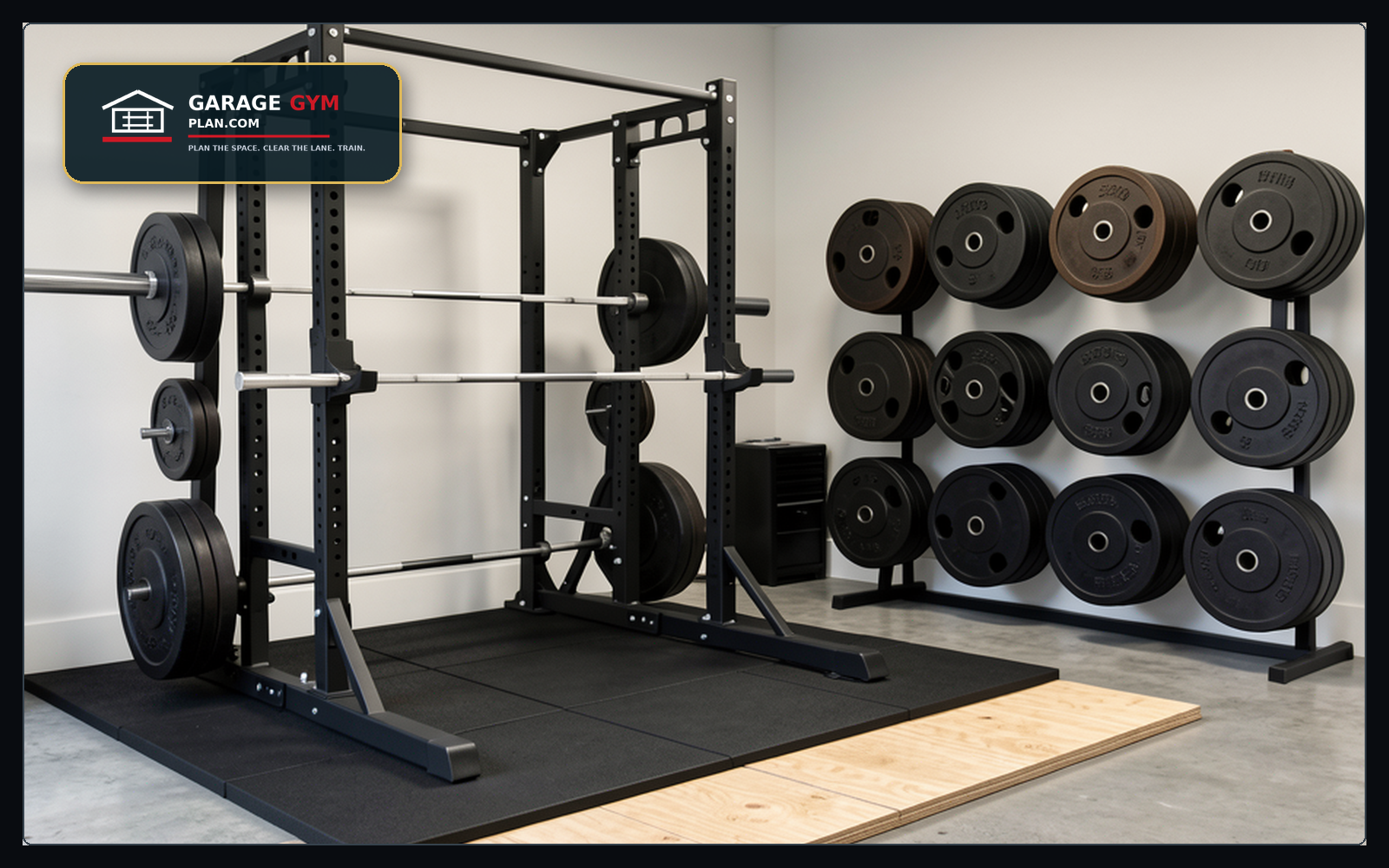
Use this guide if
- You own iron plates, bumper plates, change plates, or mixed pairs
- You need plates close to the rack without blocking the bar sleeve
- You want the storage choice to match the way you actually lift
The planning sequence
- Step 1: Put the most-used plates within one step of the rack or deadlift lane
- Step 2: Check sleeve loading clearance before choosing rack-mounted horns
- Step 3: Keep change plates visible and separate from collars and clips
- Step 4: Use wall pegs only where mounting and walking clearance both make sense
- Step 5: Leave enough floor room to carry plates without twisting around the bench
Common mistakes to avoid
- Buying a plate tree that lives in the exact spot needed for pulling
- Mounting pegs where loaded plates stick into the walking lane
- Separating plates from the bar path so every set requires extra trips
What to compare before you buy
Put plates close to the rack first. Choose a plate tree for flexible floor storage, wall pegs when wall structure allows it, or rack-mounted horns when they do not crowd the lifting lane.
| Product path | Use it when | Check before ordering | Compare |
|---|---|---|---|
| Weight Plate Tree | Best when it solves storing plates where loading the bar becomes slow, loud, or dangerous without crowding the training lane. | Verify size, mounting/support, capacity language, and return rules on the current product page. | View options |
| Wall Mounted Plate Pegs | Best when it solves storing plates where loading the bar becomes slow, loud, or dangerous without crowding the training lane. | Verify size, mounting/support, capacity language, and return rules on the current product page. | View options |
| Rack Mounted Plate Storage Horns | Best when it solves storing plates where loading the bar becomes slow, loud, or dangerous without crowding the training lane. | Verify size, mounting/support, capacity language, and return rules on the current product page. | Plan first |
- Measure plate diameter plus hand clearance around the rack upright.
- Keep heavy plates between knee and chest height when possible.
- Check wall structure, rack compatibility, sleeve diameter, and rated capacity before installing.
Garage Gym Plan may earn from qualifying retailer links. Search links are starting points, not final endorsements; verify the current product specs and installation instructions before buying.
Garage Gym Reset Kit
Measure the garage, choose the storage path, and turn the plan into a printable checklist before buying more equipment.
See the Garage Gym Reset KitTrust check for this decision
The safest choice is the one that fits your measured room and the manufacturer’s current installation requirements. Do not rely on a category name alone. Match the product dimensions to your rack zone, wall structure, walking lane, and storage reset routine.
Before checkout, compare the product page against your garage notes: clearance, mounting surface, weight capacity language, included hardware, delivery weight, and return window. If any of those details are unclear, choose the more conservative option or keep planning with the Garage Gym Reset Kit.
Next pages to plan with this
Use these guides to connect the layout decision to measurement, storage, flooring, and buying order.
Plate Storage Garage Gym: the practical planning layer
Use this section when the basic answer is not enough and you need to decide how the setup should work in a real garage. The goal is not to add more gear; it is to make the plate storage garage gym choice fit the way you train, park, clean, and move through the space.
Gaps to solve before you buy or rearrange
- Budget-Friendly & DIY Plate Storage Hacks. Creative low-cost and repurposed solutions beyond commercial products.
- Optimizing Storage for Specific Plate Types. Addressing challenges and best solutions for bumper plates, cast iron, fractional plates, or standard vs. Olympic sizes.
- Safety Best Practices for Weight Plate Storage. How to prevent tipping, tripping hazards, and ensure stability in a busy garage environment.
- Small Garage Gym Storage Layouts. Detailed examples and blueprints for maximizing plate storage in extremely confined or multi-use garage spaces.
- Integrating Plate Storage with Racks & Cages. Solutions that attach directly to or complement existing power racks, half racks, or wall-mounted systems.
Choose this approach when
- Keep the item where it is used, not simply where there is open wall space.
- Leave a clear hand path so the thing can be returned with one hand after a hard set.
- Store the most-used pieces between knee and shoulder height; reserve high shelves for backups and seasonal items.
- You can explain where the item starts, where it goes during the workout, and where it returns afterward.
- The choice improves the main training lane instead of only making the room look more finished.
- The setup still works on a tired day when you are less careful about putting everything back perfectly.
Planning modules to work through
Introduction: The Importance of Organized Plate Storage
- Enhance safety and prevent accidents in your home gym
- Improve workout efficiency and flow by having plates accessible
- Maintain a clean, professional, and motivating gym environment
Why Invest in Dedicated Plate Storage for Your Garage Gym?
- Maximize limited garage space, especially in multi-use areas
- Protect your expensive weight plates and flooring from damage
- Streamline transitions between sets and exercises
Types of Weight Plate Storage Solutions
Use this part of the plan to compare the option against your actual floor space, access path, storage return path, and budget. If it does not improve one of those, it is probably not the next upgrade.
Vertical Plate Trees
- Space-saving footprint, ideal for small areas
- Suitable for both Olympic and standard plates with appropriate sleeves
- Often portable with wheels for easy repositioning
Horizontal Plate Racks
- Excellent for bumper plates to prevent premature wear
- Provides stable, easy access to plates without heavy lifting onto pegs
- Can also store iron plates, often with less vertical space
Wall-Mounted Plate Storage
- Frees up valuable floor space completely, creating a cleaner look
- Requires sturdy wall studs for secure installation
- Offers a sleek, minimalist aesthetic for organized plate storage
Terms and fit checks to keep straight
These related ideas tend to appear around this topic. Use them as fit checks, not as a shopping list:
- Plate Storage: confirm that this detail applies to your garage, your equipment, and your training style before treating it as a must-have.
- Garage Gym: confirm that this detail applies to your garage, your equipment, and your training style before treating it as a must-have.
- Home Gym: confirm that this detail applies to your garage, your equipment, and your training style before treating it as a must-have.
- Weight Plate: confirm that this detail applies to your garage, your equipment, and your training style before treating it as a must-have.
- Plate Tree: confirm that this detail applies to your garage, your equipment, and your training style before treating it as a must-have.
- Bumper Plate: confirm that this detail applies to your garage, your equipment, and your training style before treating it as a must-have.
- Olympic Plate: confirm that this detail applies to your garage, your equipment, and your training style before treating it as a must-have.
- Storage Racks: confirm that this detail applies to your garage, your equipment, and your training style before treating it as a must-have.
- Storage Rack: confirm that this detail applies to your garage, your equipment, and your training style before treating it as a must-have.
- Wall Storage: confirm that this detail applies to your garage, your equipment, and your training style before treating it as a must-have.
Before-and-after layout check
- Measure the clear walking lane with the garage door open and closed.
- Mark the equipment footprint with painter tape, including the space needed to load, unload, and turn around.
- Stand where you will start the workout and make sure the first action is obvious.
- Put the heaviest or most awkward item back in its storage spot three times; if that feels clumsy, move the storage lower or closer.
- Check whether the setup still leaves a simple path for cleaning, parking, trash bins, bikes, or family gear.
- Take one photo from the garage entry and one photo from the rack area; if either view looks blocked, simplify before buying more.
Common questions
Why is plate storage important in a garage gym?
Proper plate storage is crucial for safety, preventing tripping hazards and injury. It also helps maximize limited garage space, keeps your gym tidy, and streamlines your workouts by making weight changes quicker and more efficient, ultimately enhancing your training experience.
What are the main types of weight plate storage?
The primary types include vertical plate trees, which are excellent for space efficiency; horizontal plate racks, often preferred for bumper plates; and wall-mounted options, which free up floor space entirely. Rack-mounted pegs also offer integrated storage within your power rack.
How do I choose the right plate storage for my garage gym?
Consider your available space, the type and number of plates you own (Olympic vs. standard, bumper vs. iron), your budget, and whether you need portability. Wall-mounted options save floor space, while trees and racks offer versatility in placement and accessibility.
Are DIY plate storage solutions effective?
Yes, DIY plate storage can be highly effective and cost-efficient, especially for those on a budget or looking for custom solutions. Simple projects using wood or PVC can provide sturdy storage for various plate types, often tailored to your specific space and needs.
How much weight can a typical plate tree hold?
The weight capacity of a plate tree varies significantly by model and construction, ranging from 300 lbs for basic models to over 1000 lbs for heavy-duty commercial-grade trees. Always check the manufacturer's specifications to ensure it safely meets your intended load.
When to keep it simple
Do not overbuild this page’s recommendation into a full-room remodel if the bottleneck is small. For many garage gyms, the right next move is one clear return spot, one better measurement, or one safer walking lane. Upgrade only after the current setup proves what is actually slowing down the workout.
For a deeper plan, pair this page with the garage gym measurement checklist, the layout cheat sheet, and the organization planner.
Plate storage weight and reach checks
Use these numbers as planning checks, not as live product claims. Final purchases should be verified against the current listing and manufacturer instructions.
- Heavy-low rule: Store the heaviest plates low and close to where they are loaded. Avoid high wall storage for heavy plates unless the system is designed and installed for it.
- Lane check: Plate trees, wall pegs, and rack-mounted horns can all work, but the winning option leaves a clear loading path to the bar.
- Buying check: Verify sleeve diameter, peg length, total load rating, footprint, caster quality, and whether bumper-plate width changes capacity.