
Garage Gym Wall Storage: How to Use the Wall Without Creating Clutter
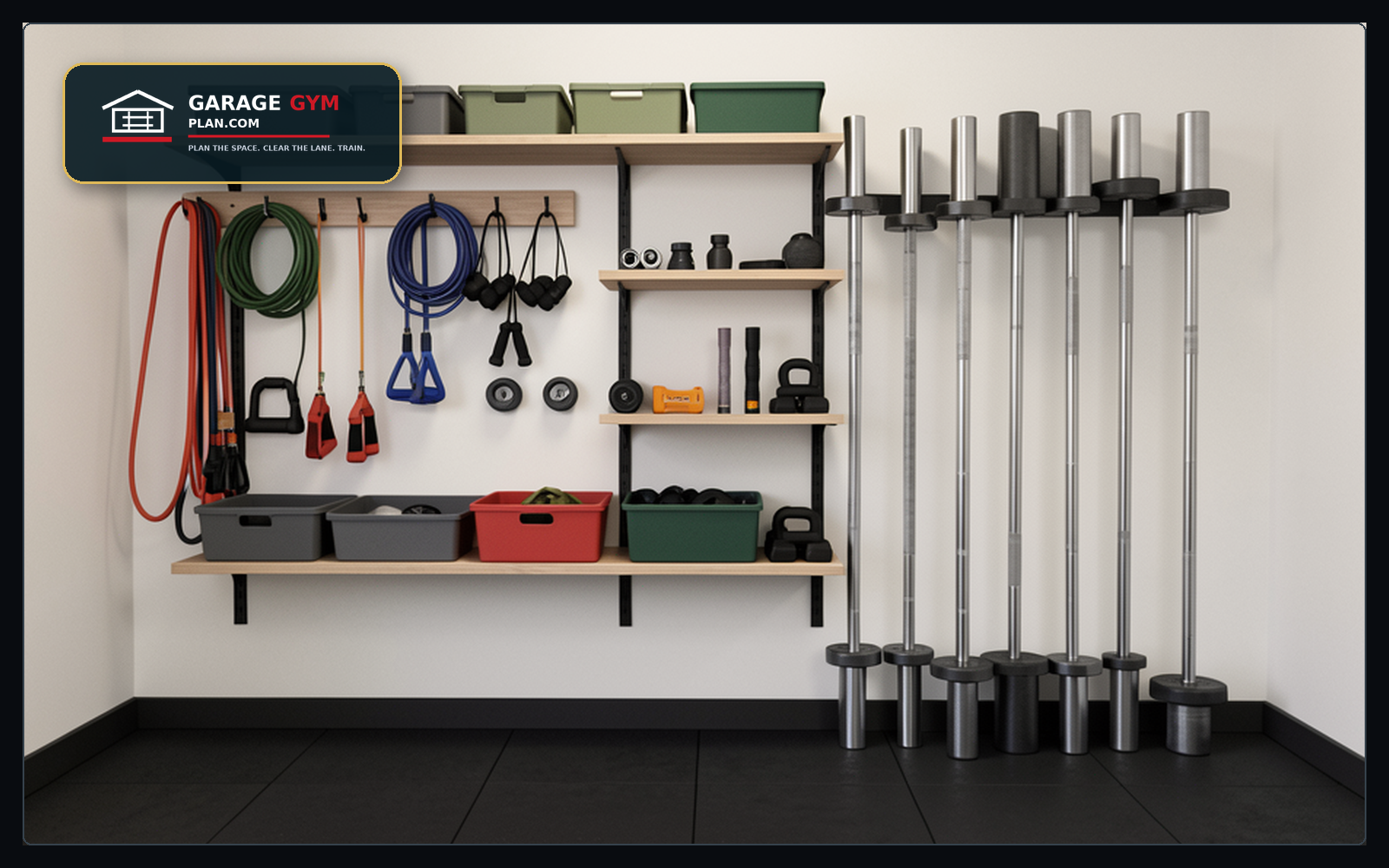
Garage gym wall storage works best when the wall is divided into zones. Heavy or long items need dedicated storage. Frequent-use accessories should live near the rack or cable station. Shelves, hooks, pegboard, slatwall, and wall panels work best when each one has a job.
The wall is not just empty space to fill. In a garage gym, the wall has to protect the training lane, car lane, door swing, garage-door hardware, and household traffic. Before mounting heavy or awkward gear, verify the wall, product instructions, mounting points, load-related claims, and clearance.
Start with this simple wall plan:
| Wall zone | Best for | Avoid | Compare |
|---|---|---|---|
| Bar zone | Straight bars or dedicated bar holders when wall setup is appropriate | Assuming every bar or specialty bar fits standard hooks | View options |
| Rack-side accessory zone | Bands, collars, straps, chains, frequent handles | Putting daily-use accessories across the garage | View options |
| Cable attachment zone | Handles, ropes, bars, ankle straps, clips | Deep bins that tangle attachments | View options |
| Tool/maintenance zone | Bar care, cleaning tools, small hardware | Mixing tools with workout-critical accessories | Plan first |
| Shelf/bin zone | Low-use items and household overflow | Blocking the walking or car lane | Plan first |
| Blank/clearance zone | Car doors, garage door tracks, rack movement, walking path | Filling every open inch with hooks | Plan first |
| Next step: Compare wall-mounted barbell racks · Compare storage systems | |||
A good wall storage system should make the floor clearer and workouts faster. If it turns the wall into a crowded hazard board, it is not doing its job.
Wall storage is different from a full storage system
This page is about wall-specific planning. If you need to compare wall, rack, shelf, floor, and modular storage as a complete system, use Garage gym storage systems.
Wall storage owns these questions:
- What should actually go on the wall?
- Which items should stay near the rack instead?
- Which items are too heavy, awkward, or risky for generic hooks?
- How do pegboard, slatwall, panels, rails, shelves, and dedicated racks differ?
- What needs to be measured or verified before mounting?
Choose the right wall storage type
Most garage gyms use a mix of simple hooks, rails, panels, shelves, and dedicated equipment holders. Do not choose by looks first. Choose by item type, frequency, and risk.
| Wall storage type | Best for | Strength | Caution |
|---|---|---|---|
| Individual wall hooks | Targeted accessory homes | Cheap and simple | Can become scattered and inconsistent |
| Hook rail | Bands, belts, ropes, light accessories | Clean row, easy reset | Less flexible if equipment changes |
| Pegboard | Small tools and light accessory organization | Visual layout | Not automatically appropriate for heavy gym gear |
| Slatwall-style system | Modular wall organization | Clean, adjustable look | Verify product limits and mounting details |
| Metal wall panel | Flexible accessories and tools | Durable-looking modular zone | Needs manufacturer-stated mounting/load data |
| Wall shelves | Low-use items, cleaning supplies, spare parts | Keeps bins off floor | Depth can narrow the walkway |
| Dedicated barbell wall rack | Straight bars when wall and clearance fit | Gets long bars off floor | Verify mounting, bar fit, and household clearance |
| Next step: Compare wall-mounted barbell racks · Compare storage systems | |||
The best first wall upgrade is often small: a bar solution, an accessory rail, or a cable attachment board. A full wall system makes sense after you know which items truly belong on the wall.
What belongs on the wall vs rack vs shelf?
The wall is useful, but it should not steal jobs from the rack or shelf.
| Item | Better home | Why |
|---|---|---|
| Bands used every workout | Rack-side peg or nearby wall hook | Fast setup and reset |
| Collars | Rack-side holder or visible hook | Used during barbell sessions |
| Cable handles | Wall board near cable station | Visible and less tangled |
| Ropes/straps | Hooks or rails | Prevents knots and floor drag |
| Straight barbells | Dedicated wall rack or vertical holder | Long items need secure homes |
| Trap bar / SSB / specialty bars | Specialty storage planning first | Shape may not fit standard wall holders |
| Cleaning supplies | Shelf/cabinet/tool wall zone | Low-use but useful to keep separate |
| Spare parts/manuals | Labeled shelf/bin | Not needed mid-workout |
| Heavy plates | Dedicated plate storage | Generic wall storage may be wrong fit |
| deadlift jack/wedge | Near plate/deadlift zone | Use-point matters more than wall display |
If an item is used mid-set, it probably belongs near the rack or station. If it is low-use, it can go on a shelf. If it is long, heavy, or awkward, it needs a dedicated fit check before going on the wall.
Wall-zone layout examples
1. Rack wall
A rack wall keeps training accessories close to the lifts.
Good options:
- Bands.
- Collars.
- Straps.
- Chains if the storage method is appropriate.
- Rack cable handles.
- Small chalk/tape/tools shelf if it does not crowd the rack.
Avoid placing hooks where they catch sleeves, interfere with J-cups/safeties, block plate loading, or sit inside the movement path.
2. Cable station wall
A cable station wall should make handles visible. The goal is to stop digging through a pile of attachments.
Good options:
- D-handles.
- Rope attachments.
- Straight bars and V-bars if the hook/rail layout fits.
- Ankle straps and clips.
- Belts and soft attachments.
Put the most-used handles at the easiest reach height. Use lower or side zones for occasional attachments.
3. Barbell wall
A barbell wall can reclaim floor space, but it has the most verification risk. Wall type, mounting hardware, product instructions, bar spacing, bar length, household traffic, and clearance all matter.
Use a barbell wall when:
- Bars are currently on the floor.
- The wall setup can be verified before installation.
- Bar access will not hit a car, door, rack, or person.
- Specialty bars are checked separately instead of forced into straight-bar storage.
If drilling or wall verification is not a good fit, compare vertical barbell storage instead.
4. Shared garage wall
A shared garage wall has to work for the gym and the household. It should not put gym gear where a car door, kid’s bike, trash bin, or garage entry path constantly collides with it.
Use this wall for:
- Clear labels.
- Household/gym separation.
- Shallow shelves.
- Light accessories at safe reach heights.
- A printed checklist near the gym zone.
Leave blank space where traffic is heavy. Empty wall space can be a feature.
5. Small garage wall
A small garage gym storage gym needs wall storage that protects the training lane.
Best first moves:
- Get straight bars off the floor if wall verification checks out.
- Put bands/collars near the rack.
- Hang cable handles where they do not swing into the lane.
- Use shallow shelves, not deep garage shelving, near the training path.
- Keep a clear vertical stripe for door swing, car access, or walking.
Small garages punish overbuilt storage. The best wall system is often the thinnest one that solves the recurring clutter.
Mounting and safety checklist before you buy or install
This section is a planning checklist, not a substitute for product instructions or qualified installation advice.
- [ ] Identify the wall type before choosing products.
- [ ] Find and verify appropriate mounting points before drilling.
- [ ] Read manufacturer instructions for the exact product.
- [ ] Verify any load-related claim from the manufacturer or qualified installer before relying on it.
- [ ] Check whether the stored item can swing, roll, scrape, or fall when grabbed quickly.
- [ ] Check car door, walking path, rack movement, and garage door clearance.
- [ ] Keep frequently used items at a reachable height.
- [ ] Keep heavy or awkward items away from kid/pet traffic where possible.
- [ ] Do not assume pegboard, slatwall, panels, or hooks are appropriate for heavy gym equipment without verification.
- [ ] Test the layout temporarily with tape before permanent installation.
A wall that looks organized in a photo can still be wrong for your garage if it blocks the movement paths that make the gym usable.
Common wall storage mistakes
Filling the wall before mapping the training lane
The wall is tempting because it looks like unused space. But if a hook sticks into the only walking path or a shelf blocks plate loading, the wall storage has made the gym worse.
Using one wall system for every item
Bands, bars, plates, cable handles, tools, and household overflow do not need the same storage method. A wall panel may be great for handles and tools but wrong for heavy or awkward gear.
Mounting too high or too low
Too high means you avoid using it. Too low means items can hit knees, pets, kids, car doors, or plates. Use reach height and traffic flow, not just visual symmetry.
Ignoring specialty bars
Trap bars, safety squat bars, curl bars, axle bars, and multi-grip bars may not sit like straight bars. Check shape and clearance before buying standard wall holders.
Overloading visual organization
A wall full of hooks can look organized and still be hard to use. If you need to move three items to reach one handle, simplify the zone.
Wall storage decision guide
| Your situation | Best next step |
|---|---|
| Bars are on the floor | Compare wall-mounted barbell racks and vertical barbell storage |
| You cannot drill or verify the wall | Favor vertical/floor/rack storage options |
| Bands and collars are scattered | Build a rack-side or nearby wall accessory zone |
| Cable handles are tangled | Create a cable attachment wall zone near the station |
| You want a full wall system | Compare hook rail, pegboard, slatwall-style, and panel systems after measuring |
| You have a small garage | Use shallow wall storage and protect the training/car lane first |
| You have specialty bars | Check specialty bar storage before buying standard hooks |
| You are unsure what to organize first | Print the garage gym organization checklist |
Related garage gym storage guides
- Garage gym organization checklist — print the checklist and measurement worksheet before buying wall hardware.
- Garage gym storage systems — compare wall storage against rack, shelf, floor, and modular systems.
- Wall-mounted barbell racks — focused straight-bar wall storage guide.
- Vertical barbell storage — no-drill alternative for bars.
- Specialty barbell storage — compatibility planning for awkward bars.
- Band peg storage — rack/wall storage for bands, collars, straps, and accessories.
- Cable attachment storage — visible homes for handles, ropes, bars, straps, and clips.
- Small garage gym storage — protect the training lane in cramped spaces.
Wall rack placement checks
A garage gym wall rack works only if the wall location supports the workout. Check reach height, plate or bar projection, door swing, car clearance, and the walking path before mounting hardware.
Wall storage should move gear off the floor while keeping the rack, bench, and mat area easier to use. If the wall system steals the side-loading lane or makes the gym wall harder to pass, shift the storage higher, shallower, or to a different zone.
Garage Gym Reset Kit
Measure the garage, choose the storage path, and turn the plan into a printable checklist before buying more equipment.
See the Garage Gym Reset KitMeasurement and buying sanity checks
Use these numbers as planning checks, not as live product claims. Final purchases should be verified against the current listing and manufacturer instructions.
- Measure before product: Write down the exact wall width, depth, ceiling height, car-door swing, walking lane, and where the item will reset after a workout.
- Use price bands carefully: Treat price ranges as planning estimates only. Verify current prices, shipping, dimensions, ratings, and return policies on the live listing.
- Keep the lane clear: The best-looking storage is a bad choice if it creates a toe-stub, blocks the car, hides daily gear, or requires moving three items before training.