
Garage Gym Storage Systems: How to Choose the Right Setup
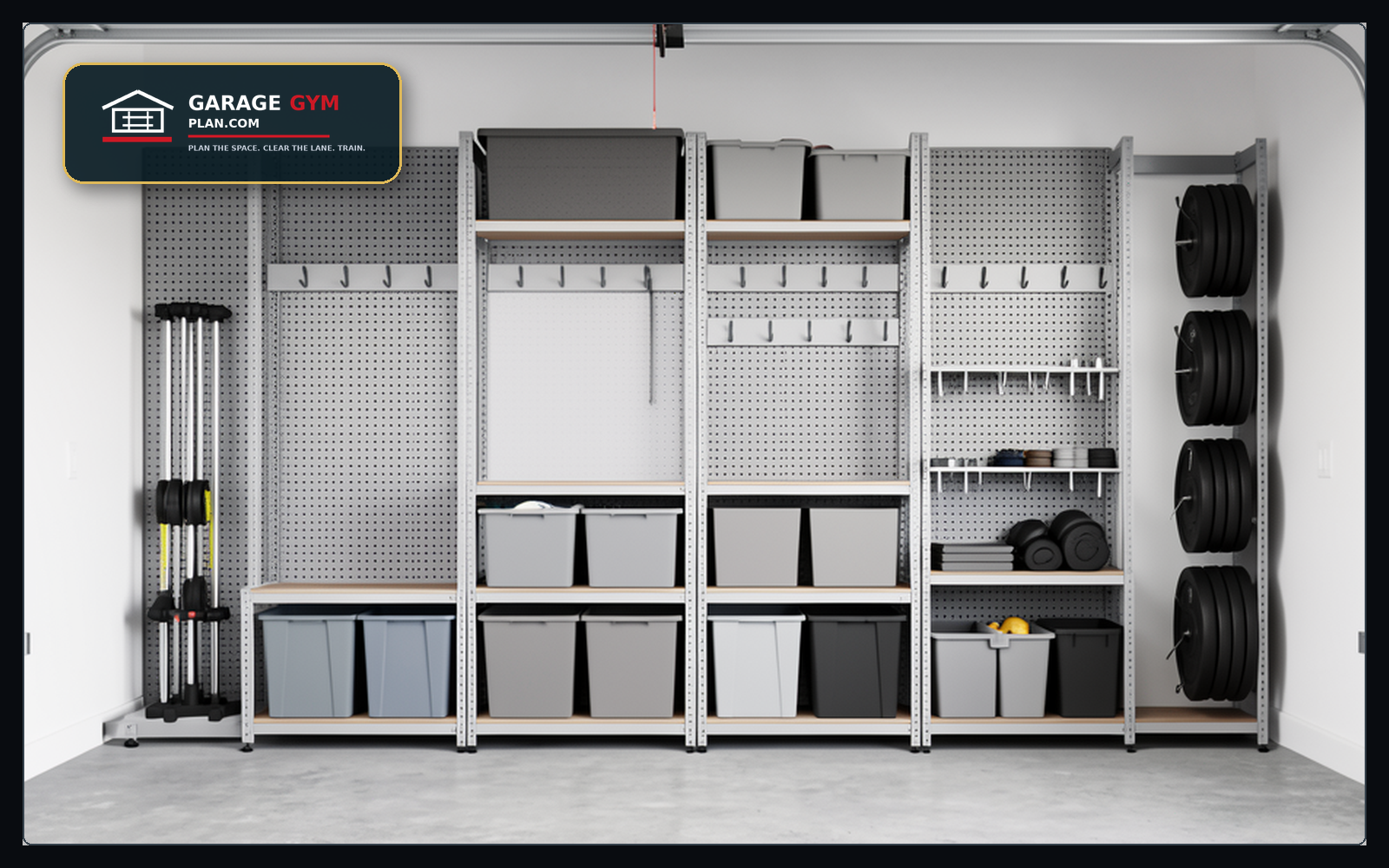
A good garage gym storage system does more than make the room look clean. It keeps the equipment you use most often close to the workout, moves awkward gear out of the walk path, and gives every item a reset point when training is over.
The best system depends on what is causing the clutter. Wall panels are useful for flexible accessories and tools. Rack-mounted storage is useful for bands, collars, handles, and items you use during a lift. Shelves and bins work better for low-use gear. Dedicated barbell and plate storage is safer and cleaner than trying to treat every heavy item like it belongs on a hook.
Use the system to solve the actual problem in your gym:
| If your main problem is... | Start with... | Why | Compare |
|---|---|---|---|
| Bars are on the floor | Barbell storage | Long items create trip hazards and waste floor space | View options |
| Bands, collars, and handles are scattered | Rack or wall accessory storage | Small gear needs visible homes close to where it is used | View options |
| The whole wall is messy | Wall panel, slatwall, pegboard, or hook rail | Gives flexible homes to many accessory types | View options |
| Plates block the lifting path | Plate tree, rack storage, or plate zone | Heavy gear should not live in the training lane | View options |
| Household items mix with gym gear | Shelves, cabinets, and labeled bins | Separates gym storage from garage overflow | Plan first |
| You still park a car | Wall and vertical storage first | Keeps the car lane and door swing clear | Plan first |
| Next step: Plan garage gym wall storage · Use the organization checklist | |||
Do not start by asking, “What is the best storage system?” Start by asking, “What equipment keeps getting in the way?”
The five garage gym storage system types
Most home gyms use a mix of five systems: garage gym wall storage, rack storage, shelf/bin storage, floor-based storage, and dedicated specialty storage. The right setup is usually a combination, not one perfect product.
1. Wall storage systems
Wall storage systems include wall panels, slatwall-style setups, pegboards, hook rails, individual hooks, and purpose-built wall racks. They are best when floor space is limited or when small and medium items need to stay visible.
Wall storage works well for:
- Bands.
- Collars.
- Cable handles.
- Ropes and straps.
- Jump ropes.
- Belts.
- Light tools and maintenance items.
- Some straight-bar storage when the mount and wall setup are appropriate.
Wall storage is less ideal for:
- Heavy plates unless the system is specifically designed and verified for that use.
- Specialty bars that do not sit securely on standard hooks.
- Items that swing into a car lane, door path, or rack movement area.
- Walls where the mounting structure is uncertain.
The main advantage is flexibility. You can move hooks, add accessory zones, and see everything at once. The main risk is overconfidence: a wall that looks organized is not automatically safe for heavy or awkward equipment.
2. Rack-mounted storage
Rack-mounted storage keeps workout accessories near the lift. This can include band pegs, collar holders, plate pins, cable attachment holders, utility hooks, and small shelves attached to or placed near the rack.
Rack storage works well for:
- Bands used for warmups or resistance.
- Collars used every barbell session.
- Handles or straps used with a rack-mounted pulley.
- Small change plates if the rack and attachment are suitable.
- Dip belts, chains, and lifting straps.
The advantage is speed. If you need an item during the workout, it should not live across the garage in a cabinet. The downside is crowding. If the rack becomes cluttered, catches clothing, or makes plate loading awkward, the storage is too close to the work area.
Use rack storage for items that support training, not every item you own.
3. Shelves, cabinets, and bins
Shelves and bins are the best system for low-frequency gear and household separation. They are not glamorous, but they keep the garage from swallowing the gym.
Use shelf/bin storage for:
- Cleaning supplies.
- Spare hardware.
- Extra bands or backup gear.
- Shoes, wraps, sleeves, tape, and chalk.
- Manuals and tools.
- Seasonal household items that must share the garage.
Avoid using deep bins for items you need mid-workout. If collars, handles, or bands go into a general “gym stuff” bin, they will be annoying to find and easy to forget.
A good shelf system uses labels by function: cable attachments, bar care, straps/wraps, cleaning, spare parts, household overflow. A bad shelf system creates one big junk drawer.
4. Floor-based storage
Floor storage is not the enemy. Bad floor storage is the enemy.
A plate tree, dumbbell stand, kettlebell row, vertical barbell holder, or deadlift-jack home can make a garage gym safer if it stays against a wall or outside the training lane.
Floor systems work well for:
- Plates.
- Dumbbells.
- Kettlebells.
- Sandbags.
- Vertical barbell holders.
- Deadlift jacks and wedges.
- Heavy items that are safer stored low.
The test is simple: does the floor storage clear the workout path, or does it become the thing you now have to step around?
5. Dedicated barbell, plate, and specialty storage
Some equipment deserves dedicated storage. Barbells, specialty bars, heavy plates, dumbbells, and kettlebells are not the same as bands or jump ropes.
Dedicated storage matters when:
- The item is long, heavy, awkward, or shaped differently from standard accessories.
- The item can fall, roll, scratch a car, or block a walk path.
- You use it often enough that setup speed matters.
- Generic hooks would create more risk or hassle than they solve.
This is where many garage gym storage systems fail. They solve the easy visual clutter while leaving the barbell, plates, or trap bar in the way.
Match the system to the equipment
| Equipment | Better storage direction | Avoid |
|---|---|---|
| Straight barbells | Wall rack or vertical holder, depending on clearance | Leaning bars loose in a corner |
| Specialty bars | Specialty-specific storage or carefully planned floor/wall solution | Assuming every specialty bar fits standard hooks |
| Bands | Rack pegs, wall pegs, or visible hooks | Deep bins for daily-use bands |
| Collars | Rack-side holder or small visible hook/bin | Tossing them on shelves or plates |
| Cable handles | Wall board, hook rail, or rack-side attachment zone | Tangled pile in a tote |
| Plates | Plate tree, rack storage, or dedicated plate zone | Stacks in the walking path |
| Dumbbells/kettlebells | Floor rack or low storage line | High shelves or random corners |
| Cleaning/tools | Shelf, cabinet, or wall tool zone | Mixing with workout accessories |
| deadlift jack/wedge | Near the plate/deadlift area | Across the garage from where it is used |
This equipment-first view prevents a common mistake: buying a beautiful wall system and then realizing the biggest problem was plate, bar, or rack-zone clutter.
Wall panel vs pegboard vs slatwall vs hooks
The broad wall-storage category can mean several different things. Choose based on adjustability, cost, appearance, and what you actually need to hang.
| Wall option | Best for | Watch out for |
|---|---|---|
| Individual hooks | Cheap targeted fixes | Can become scattered and inconsistent |
| Hook rail | Simple row of accessories | Limited flexibility if equipment changes |
| Pegboard | Light tools and accessory layout | Not automatically suited for heavy gym gear |
| Metal wall panel | Flexible accessory organization | Needs manufacturer-stated mounting and load details |
| Slatwall-style system | Clean modular look | Can become overkill if you only need a few hooks |
| Purpose-built wall rack | Barbells or specific gym gear | Must match item shape, wall setup, and clearance |
| Next step: Plan garage gym wall storage · Use the organization checklist | ||
For a first version, do not overbuild the wall. Place the items you use most, test the layout for a week, then decide whether the wall deserves a modular system.
Rack zone vs wall zone vs shelf zone
A storage system works best when each zone has a job.
Use the rack zone for speed
Store items here when you use them during training:
- Collars.
- Bands.
- Straps.
- Cable handles used with the rack.
- Small change plates if appropriate.
Question to ask: “Would I want this within arm’s reach during a set or between sets?”
Use the wall zone for visibility
Store items here when they should be off the floor and easy to see:
- Handles.
- Ropes.
- Jump ropes.
- Belts.
- Barbell storage if the wall solution fits.
- Tools and maintenance items.
Question to ask: “Does this item need to be visible but not necessarily attached to the rack?”
Use the shelf zone for lower-use storage
Store items here when they do not need to be grabbed mid-workout:
- Cleaning supplies.
- Spare parts.
- Manuals.
- Seasonal gear.
- Backups and overflow.
Question to ask: “Will putting this in a bin slow down an actual workout?”
Use the floor zone for heavy stable storage
Store items here when low storage is safer or more practical:
- Plates.
- Dumbbells.
- Kettlebells.
- Vertical bar holders.
- Deadlift tools.
Question to ask: “Can this live on the floor without stealing the lifting or walking lane?”
DIY vs bought garage gym storage systems
DIY can be a good fit when the need is simple, the load is modest, and the household understands the setup. Bought systems can be better when you need cleaner modularity, purpose-built attachments, or product documentation.
| Path | Best when | Tradeoff |
|---|---|---|
| DIY hooks and shelves | You need cheap, targeted organization | Requires more judgment and consistency |
| Basic bought hooks/rails | You need quick accessory storage | May not solve heavy or awkward gear |
| Modular wall system | You want a clean expandable wall zone | Can cost more than the problem requires |
| Rack attachments | Gear is used during lifts | Can crowd the rack if overused |
| Dedicated gym storage products | Bars, plates, dumbbells, specialty items need proper homes | Product fit and specs must be verified |
| Next step: Plan garage gym wall storage · Use the organization checklist | ||
The smart path is often hybrid: DIY or low-cost storage for low-risk accessories, dedicated products for bars/plates/heavy items, and modular systems only where flexibility matters.
Budget path: start cheap, then modularize
Under $50: stop the small-gear spread
Start with visible homes for small items:
- Hooks for bands and ropes.
- Small bins for backup accessories.
- Labels for shelves.
- A rack-side collar home.
- Tape marks for training and car lanes.
This budget level will not transform the garage, but it can remove the daily irritation.
$50 to $200: solve one main constraint
Pick one problem and fix it well:
- Barbell holder.
- Accessory wall.
- Cable handle board.
- Plate storage improvement.
- Shelf/cabinet zone for non-gym overflow.
This is the range where most garage gyms can make the biggest practical improvement.
$200+: build the system around zones
Spend more when the layout is clear:
- Modular wall panel or slatwall-style system.
- Dedicated bar and plate storage.
- Rack attachments for frequently used gear.
- Better shelves/cabinets for household separation.
- Custom printable checklist or wall map.
Do not spend premium money before mapping the wall, rack, floor, shelf, and car-lane zones.
What not to systemize
Not every clutter problem deserves a full system.
Be careful with:
- Specialty bars that do not fit standard hooks cleanly.
- Heavy plates on generic wall hardware.
- Hooks placed where they can hit a car or door.
- Storage inside the rack path.
- Deep bins for daily-use accessories.
- Wall systems installed before checking mounting requirements.
- Buying a full panel system when one bar rack and three hooks would solve the problem.
A garage gym storage system should reduce decisions. If it adds new rules, new hazards, or new places to search, simplify it.
- Start with the one item category that is currently on the floor most often.
- Buy modular pieces only after you know what needs to move weekly.
- Skip any system that looks organized in photos but makes your most-used gear harder to reach.
| System | Best first job | Proof it fits |
|---|---|---|
| Rack-mounted storage | Plates, collars, attachments, and items used during barbell work. | You can load plates without blocking safeties, walkways, or the car lane. |
| Wall storage | Light accessories that need visibility and fast return after training. | Mounting surface, load rating, and hand height are verified. |
| Shelves or cabinets | Backups, cleaners, towels, shoes, and items that do not need to be visible every set. | The shelf depth does not steal the lifting lane or garage-door path. |
| Floor-based storage | Heavy movable pieces like kettlebells, dumbbells, and specialty implements. | The footprint is stable and does not create a toe-stub path around the rack. |
Pick one primary system for the mess you actually have. Most garages work better with a rack zone, a wall zone, and one shelf zone than with a single expensive system trying to hold everything.
Garage gym storage system decision guide
Related garage gym storage guides
If you came here from the main storage ideas page, choose the deeper guide that matches your bottleneck:
- Need floor clearance in a tight space? Read the small garage gym storage gym storage guide.
- Need bars off the floor? Compare wall-mounted barbell racks or vertical barbell storage.
- Have awkward bars? Start with specialty barbell storage.
- Need accessory organization? Use band peg storage and cable attachment storage.
- Need to fix deadlift setup? Compare deadlift jacks and wedges.
- Want a wall plan? Read the garage gym wall storage guide.
- Want a step-by-step reset? Use the garage gym organization checklist.
Measurement and buying sanity checks
Use these numbers as planning checks, not as live product claims. Final purchases should be verified against the current listing and manufacturer instructions.
- Measure before product: Write down the exact wall width, depth, ceiling height, car-door swing, walking lane, and where the item will reset after a workout.
- Use price bands carefully: Treat price ranges as planning estimates only. Verify current prices, shipping, dimensions, ratings, and return policies on the live listing.
- Keep the lane clear: The best-looking storage is a bad choice if it creates a toe-stub, blocks the car, hides daily gear, or requires moving three items before training.
Garage Gym Reset Kit
Measure the garage, choose the storage path, and turn the plan into a printable checklist before buying more equipment.
See the Garage Gym Reset Kit