
Dumbbell Storage for Garage Gyms: Racks, Shelves, Corners, and Walkways
Dumbbells need a home that is close enough to use and far enough from the rack, bench, and car path to stay out of the way.
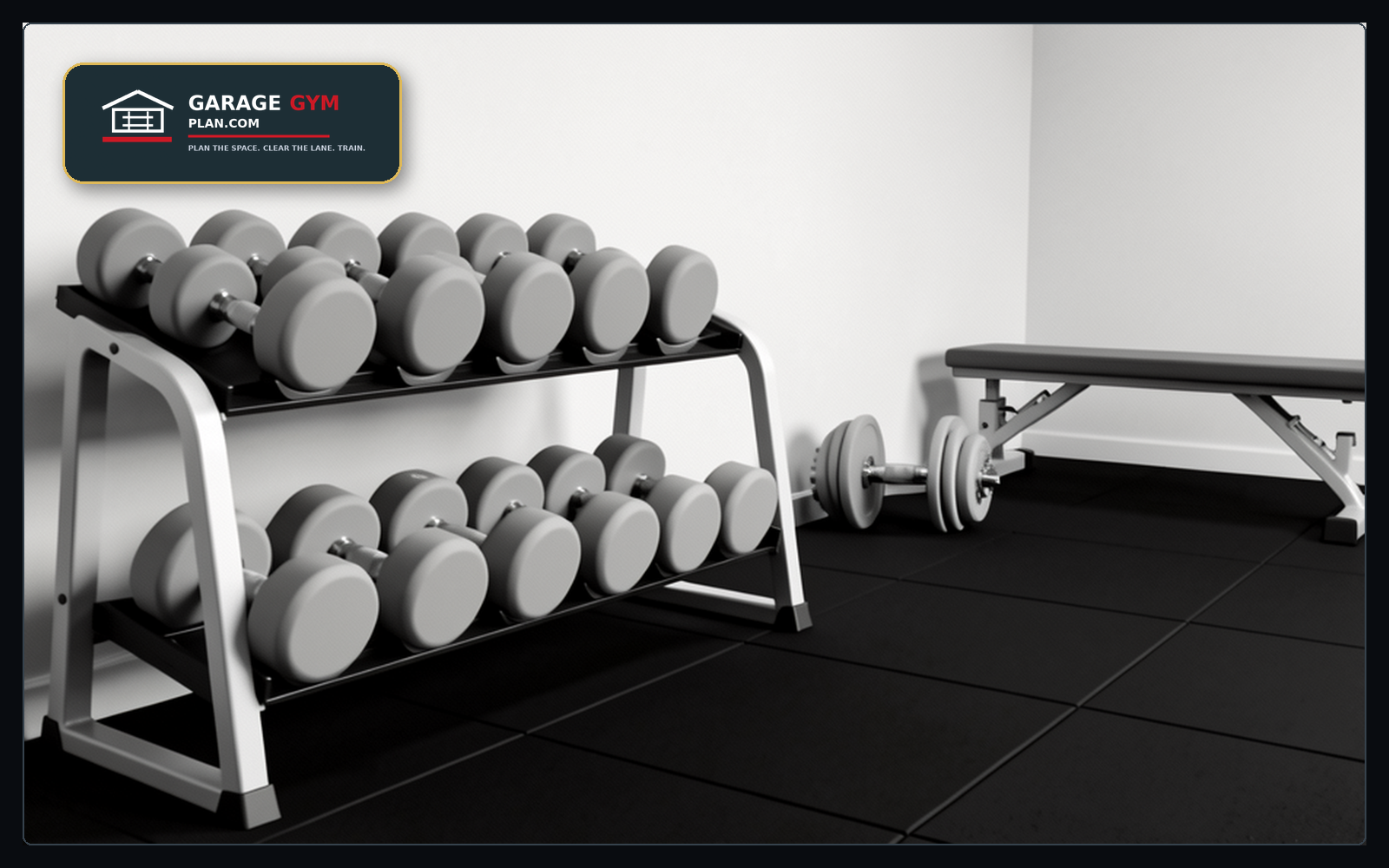
Use this guide if
- You use fixed pairs, adjustable dumbbells, or a mix of handles and plates
- Your dumbbells drift into the training lane after every workout
- You need storage that works for quick accessory sessions
The planning sequence
- Step 1: Choose the dumbbell zone after the rack and bench paths are set
- Step 2: Keep the heaviest pairs between knee and waist height when possible
- Step 3: Leave room to stand in front of the rack without backing into plates or a car
- Step 4: Store adjustable-dumbbell parts in one tray or shelf so changes are faster
- Step 5: Use labels or pairs-by-weight order if multiple people share the gym
Common mistakes to avoid
- Putting a dumbbell rack where bench setup should happen
- Buying a wide rack before measuring car-door clearance
- Storing handles, pins, collars, and plates in separate corners
What to compare before you buy
Use a compact tiered rack for fixed dumbbells, a stand for adjustable dumbbells, and a floor tray only when the bells must live under a shelf or beside the rack.
| Product path | Use it when | Check before ordering | Compare |
|---|---|---|---|
| Dumbbell Storage Rack | Best when it solves letting dumbbells spread across the floor until the walking lane and bench setup are blocked without crowding the training lane. | Verify size, mounting/support, capacity language, and return rules on the current product page. | View options |
| Adjustable Dumbbell Stand | Best when it solves letting dumbbells spread across the floor until the walking lane and bench setup are blocked without crowding the training lane. | Verify size, mounting/support, capacity language, and return rules on the current product page. | View options |
| Compact Dumbbell Tray | Best when it solves letting dumbbells spread across the floor until the walking lane and bench setup are blocked without crowding the training lane. | Verify size, mounting/support, capacity language, and return rules on the current product page. | Plan first |
- Measure handle clearance and the deepest pair of dumbbells, not just the rack width.
- Keep pickup space open so you do not lift dumbbells from behind a bench or storage bin.
- Check rack capacity, shelf lip, shipping weight, and floor contact points before buying.
Garage Gym Plan may earn from qualifying retailer links. Search links are starting points, not final endorsements; verify the current product specs and installation instructions before buying.
Garage Gym Reset Kit
Measure the garage, choose the storage path, and turn the plan into a printable checklist before buying more equipment.
See the Garage Gym Reset KitTrust check for this decision
The safest choice is the one that fits your measured room and the manufacturer’s current installation requirements. Do not rely on a category name alone. Match the product dimensions to your rack zone, wall structure, walking lane, and storage reset routine.
Before checkout, compare the product page against your garage notes: clearance, mounting surface, weight capacity language, included hardware, delivery weight, and return window. If any of those details are unclear, choose the more conservative option or keep planning with the Garage Gym Reset Kit.
Next pages to plan with this
Use these guides to connect the layout decision to measurement, storage, flooring, and buying order.
Dumbbell Storage Garage Gym: the practical planning layer
Use this section when the basic answer is not enough and you need to decide how the setup should work in a real garage. The goal is not to add more gear; it is to make the dumbbell storage garage gym choice fit the way you train, park, clean, and move through the space.
Gaps to solve before you buy or rearrange
- DIY Dumbbell Rack Plans. Step-by-step guides or ideas for building custom weight racks, appealing to budget-conscious or handy users.
- Specific Storage for Adjustable Dumbbells. Differentiated solutions and considerations for storing adjustable sets vs. traditional fixed weights, which often have unique footprint requirements.
- Integrating Dumbbell Storage with Other Gym Equipment. How to plan a cohesive layout where weight storage complements and doesn't impede access to other fitness gear like benches, squat racks, or cardio machines.
- Safety and Durability of Storage. Beyond just product reviews, covering aspects like proper installation, weight capacity limits, floor protection, and materials for longevity in a garage environment.
- Aesthetic Considerations & Hidden Storage. Tips for making weight storage look good, blending it into the garage, or innovative hidden solutions to maintain a clean and uncluttered look.
Choose this approach when
- Keep the item where it is used, not simply where there is open wall space.
- Leave a clear hand path so the thing can be returned with one hand after a hard set.
- Store the most-used pieces between knee and shoulder height; reserve high shelves for backups and seasonal items.
- You can explain where the item starts, where it goes during the workout, and where it returns afterward.
- The choice improves the main training lane instead of only making the room look more finished.
- The setup still works on a tired day when you are less careful about putting everything back perfectly.
Planning modules to work through
Introduction: Why Smart Dumbbell Storage Matters for Your Garage Gym
- Maximize usable workout space and keep the area clutter-free.
- Ensure safety by preventing trip hazards and protecting equipment.
- Enhance the aesthetic and functionality of your personal gym.
Understanding Different Types of Dumbbell Storage Solutions
Use this part of the plan to compare the option against your actual floor space, access path, storage return path, and budget. If it does not improve one of those, it is probably not the next upgrade.
Horizontal Dumbbell Racks:
- Traditional multi-tier designs for various dumbbell sets.
- Good for hex, rubber, and cast iron dumbbells; often space-intensive.
- Consider weight capacity and footprint.
Vertical Dumbbell Trees:
- Compact, upright design ideal for smaller spaces.
- Typically suited for lighter to medium weight hex dumbbells or some adjustable sets.
- Check stability and individual cradle size.
Wall-Mounted Storage:
- Utilizes vertical wall space, keeping floor clear.
- Options include shelves, individual holders, or plate-loadable systems.
- Requires secure installation into studs; ideal for fixed dumbbells or smaller sets.
Adjustable Dumbbell Stands:
- Designed specifically for adjustable dumbbells (e.g., Bowflex, PowerBlock).
- Provides ergonomic access and often includes a tray or cradle.
- Ensure compatibility with your specific adjustable dumbbell model.
Terms and fit checks to keep straight
These related ideas tend to appear around this topic. Use them as fit checks, not as a shopping list:
- Dumbbell Storage: confirm that this detail applies to your garage, your equipment, and your training style before treating it as a must-have.
- Garage Gym: confirm that this detail applies to your garage, your equipment, and your training style before treating it as a must-have.
- Home Gym: confirm that this detail applies to your garage, your equipment, and your training style before treating it as a must-have.
- Dumbbell Racks: confirm that this detail applies to your garage, your equipment, and your training style before treating it as a must-have.
- Storage Racks: confirm that this detail applies to your garage, your equipment, and your training style before treating it as a must-have.
- Gym Storage: confirm that this detail applies to your garage, your equipment, and your training style before treating it as a must-have.
- Home Gyms: confirm that this detail applies to your garage, your equipment, and your training style before treating it as a must-have.
- Storage Rack: confirm that this detail applies to your garage, your equipment, and your training style before treating it as a must-have.
- Weight Storage: confirm that this detail applies to your garage, your equipment, and your training style before treating it as a must-have.
- Storage Solution: confirm that this detail applies to your garage, your equipment, and your training style before treating it as a must-have.
Before-and-after layout check
- Measure the clear walking lane with the garage door open and closed.
- Mark the equipment footprint with painter tape, including the space needed to load, unload, and turn around.
- Stand where you will start the workout and make sure the first action is obvious.
- Put the heaviest or most awkward item back in its storage spot three times; if that feels clumsy, move the storage lower or closer.
- Check whether the setup still leaves a simple path for cleaning, parking, trash bins, bikes, or family gear.
- Take one photo from the garage entry and one photo from the rack area; if either view looks blocked, simplify before buying more.
Common questions
How can I store dumbbells in a small garage gym without taking up too much space?
For a small garage gym, consider vertical dumbbell trees or wall-mounted storage solutions. Vertical trees have a small footprint, holding dumbbells upright, while wall-mounted racks free up floor space entirely, making them excellent choices for maximizing your limited area and keeping pathways clear.
What's the difference between a dumbbell rack and a dumbbell tree?
A dumbbell rack typically features horizontal tiers designed to hold multiple pairs of dumbbells side-by-side, often accommodating a wider range of weights. A dumbbell tree, on the other hand, is a more compact, upright structure with individual slots or cradles, usually optimized for smaller sets or lighter dumbbells and occupying less floor space.
Are wall-mounted dumbbell storage solutions safe for heavy dumbbells?
Yes, wall-mounted dumbbell storage can be very safe for heavy dumbbells, provided it is properly installed into wall studs using appropriate hardware. Always check the product's weight capacity and ensure your wall's structure can support the combined weight of the rack and dumbbells to prevent accidents and damage.
Can I build my own DIY dumbbell storage?
Absolutely! You can build DIY dumbbell storage, often using wood or sturdy metal components. Simple shelving units, A-frame racks, or even custom wall-mounted solutions can be constructed with basic carpentry skills, offering a cost-effective and customizable way to organize your weights.
How do I choose the right size dumbbell rack for my garage gym?
To choose the right size, first measure your available floor and wall space, accounting for clearance around the rack. Next, determine the number and total weight of your current and future dumbbell collection. Select a rack with sufficient tiers, length, and weight capacity to accommodate all your dumbbells comfortably and safely.
When to keep it simple
Do not overbuild this page’s recommendation into a full-room remodel if the bottleneck is small. For many garage gyms, the right next move is one clear return spot, one better measurement, or one safer walking lane. Upgrade only after the current setup proves what is actually slowing down the workout.
For a deeper plan, pair this page with the garage gym measurement checklist, the layout cheat sheet, and the organization planner.
Dumbbell storage checks
Use these numbers as planning checks, not as live product claims. Final purchases should be verified against the current listing and manufacturer instructions.
- Weight and height: Heavier dumbbells belong on lower tiers. Do not put heavy pairs high just because a rack photo looks tidy.
- Footprint: Measure rack depth plus the space needed to bend, lift, and turn. A rack that technically fits can still block the walking lane.
- Buying check: Verify dumbbell handle style, hex/round shape, rack tier spacing, width, load rating, and whether future heavier pairs will fit.